If you own a pool in California, you've already discovered that standard pool care advice doesn't always apply here. Our summers regularly push past 105°F, our water has unique mineral content, and UV intensity is off the charts — all of which dramatically affects how quickly pool chemicals are consumed and how hard they are to keep balanced.
After years of servicing pools across California, I've put together this guide specifically for our region. Follow these steps and your pool water will be safe, clear, and comfortable all season long.
Why Chemical Balance Matters More in California
Unbalanced pool water is more than an inconvenience — it's a safety and equipment issue. Too much chlorine burns eyes and skin. Too little, and bacteria thrive. Incorrect pH causes your sanitizer to stop working efficiently, meaning you're spending money on chemicals that aren't actually protecting anyone.
In California's climate, the stakes are higher because:
- Extreme heat accelerates chemical consumption. UV rays from our intense sun break down free chlorine up to 3x faster than in cooler climates.
- Evaporation concentrates minerals. As water evaporates (and it evaporates fast here), calcium, magnesium, and other minerals become more concentrated, driving up calcium hardness and total dissolved solids.
- Heavy bather loads in summer. Pool parties, kids, and extended swim seasons mean more organic contaminants (sweat, sunscreen, body oils) entering your water.
- California tap water is often hard. Many California municipal water supplies have higher calcium content, meaning you start with a disadvantage.
The Five Parameters You Must Monitor
Pool water chemistry comes down to five key measurements. Here's the ideal range for each — and the California-specific considerations you need to know.
| Parameter | Ideal Range | Too Low | Too High | CA Frequency |
|---|---|---|---|---|
| Free Chlorine | 2.0 – 4.0 ppm | Algae, bacteria | Skin/eye irritation | 2–3x per week |
| pH | 7.4 – 7.6 | Corrosion, eye burn | Chlorine ineffective | Weekly |
| Total Alkalinity | 80 – 120 ppm | pH bounces wildly | Cloudy water, scale | Bi-weekly |
| Calcium Hardness | 200 – 400 ppm | Etches plaster | Scale buildup | Monthly |
| Cyanuric Acid (Stabilizer) | 30 – 50 ppm | Chlorine burns off fast | Chlorine lock | Monthly |
Step 1: Test Your Water First
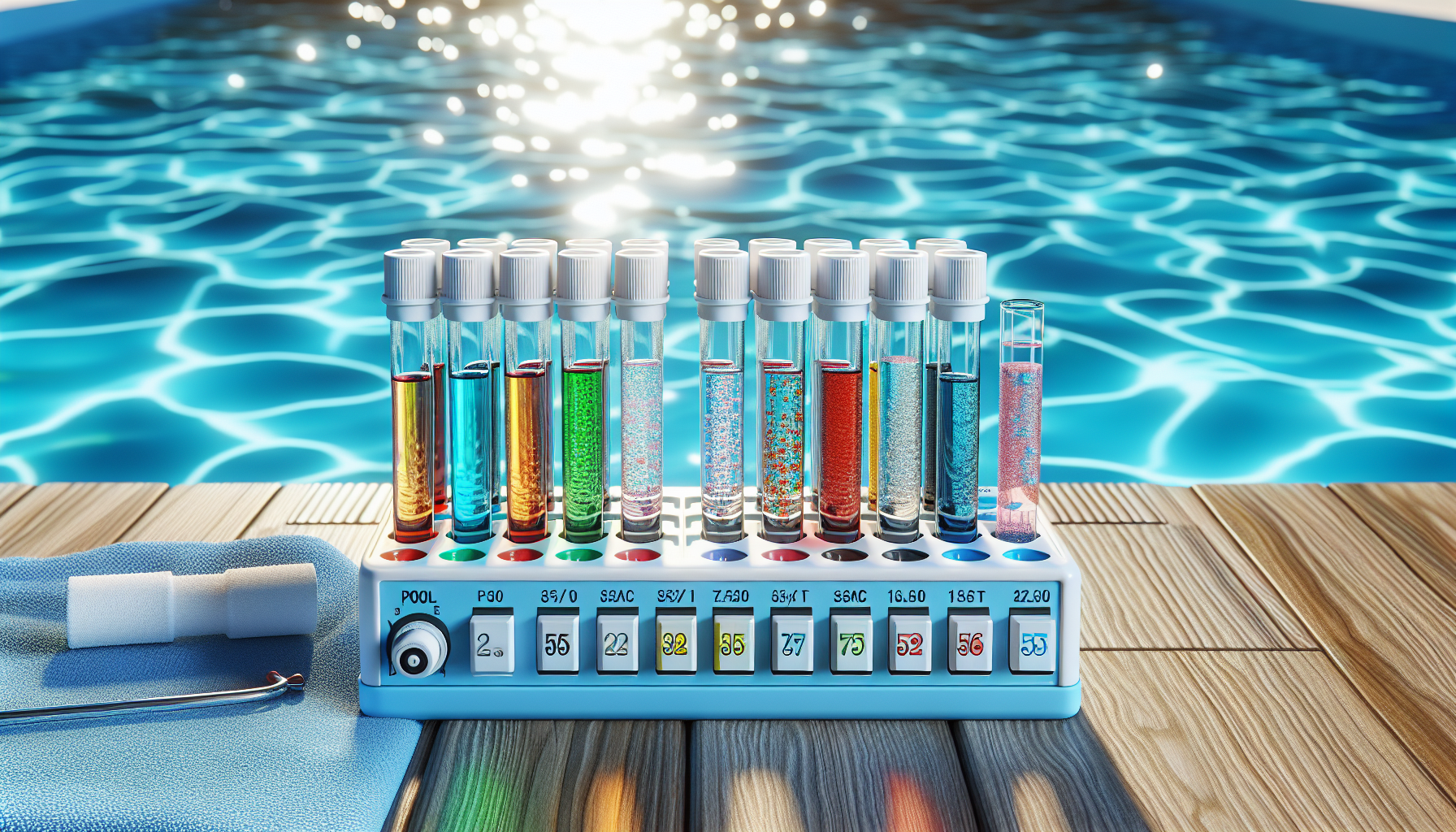
Never add chemicals blindly. Always test first. In California, I recommend testing twice a week during peak summer (June–September) and once a week the rest of the year. Your options:
- Test strips — Quick and cheap, but less accurate. Good for a daily gut-check between professional visits.
- Liquid test kits — More accurate than strips. The Taylor K-2006 is the industry standard.
- Digital testers — Fast and accurate, but require regular calibration. The LaMotte ColorQ Pro is reliable.
- Professional testing — Pool supply stores and services like Elevate Aqua test with commercial-grade equipment and can catch issues strips miss, like total dissolved solids and copper levels.
Step 2: Balance pH First
pH is the master control of your pool chemistry. When pH is off, no other chemical works correctly. Chlorine, for example, is 90% effective at pH 7.0 but only 10% effective at pH 8.0 — that's a massive difference for the same amount of product you're adding.
Raising pH (if below 7.4)
Add sodium carbonate (soda ash). Dose: 6 oz per 10,000 gallons raises pH by approximately 0.2. Dissolve in a bucket of water first, then broadcast across the pool with the pump running. Wait 4 hours before retesting.
Lowering pH (if above 7.6)
Add muriatic acid or sodium bisulfate (dry acid). Muriatic acid works faster but requires more caution — add it near a return jet while the pump runs, never near the skimmer. Dose: 12 oz of muriatic acid per 10,000 gallons lowers pH by approximately 0.2.
Step 3: Adjust Total Alkalinity
Think of total alkalinity (TA) as pH's buffer. When TA is in range (80–120 ppm), pH stays stable. When TA is low, pH bounces up and down with every rain, swimmer, or chemical addition — this is called "pH bounce" and it's exhausting to correct.
Raising Total Alkalinity
Add sodium bicarbonate (baking soda). Use 1.5 lbs per 10,000 gallons to raise TA by approximately 10 ppm. This is one of the safest pool chemicals — no special precautions needed beyond standard care.
Lowering Total Alkalinity
Use muriatic acid, but apply it differently than for pH. Add the acid in one spot near the deep end with the pump off, then wait 1 hour before turning the pump back on. This method specifically targets TA without dropping pH as dramatically.
Step 4: Manage Chlorine — The California Way
Chlorine is your pool's primary sanitizer, but in California conditions, it requires special management. The biggest issue is UV degradation. California's intense summer sun can destroy 90% of your unstabilized chlorine in just 2 hours.
Use Cyanuric Acid (Stabilizer)
Cyanuric acid (CYA) is the sunscreen for your chlorine. Keep it between 30–50 ppm and your chlorine will last all day instead of burning off by noon. Most stabilized chlorine tablets (trichlor) already contain CYA, which is why they're popular in sunny climates.
However, watch for CYA creep — in our climate, evaporation concentrates CYA over time. If CYA rises above 80 ppm, chlorine becomes less effective (chlorine lock), and the only fix is partial draining and refilling.
Shock Weekly During Summer
Weekly shocking during June–September is non-negotiable in California. Shocking breaks down combined chlorine (chloramines) — the compounds responsible for the "chlorine smell" that isn't actually free chlorine. Use calcium hypochlorite shock at 1 lb per 10,000 gallons. Always shock in the evening so UV doesn't destroy it before it works.
Step 5: Monitor Calcium Hardness
Calcium hardness is often overlooked, but in California it's a serious concern. Our tap water already comes in at 150–250 ppm, and evaporation pushes that higher throughout the season. High calcium causes:
- White scale deposits on pool surfaces and equipment
- Clogged filters and reduced pump efficiency
- Cloudy water that resists clarifiers
- Damage to pool heaters and salt cells
If calcium hardness exceeds 500 ppm, your best option is a partial drain and refill. Replace 20–30% of the water with fresh tap water, retest, and repeat if necessary. Some pool owners invest in a reverse osmosis (RO) water treatment service, which filters pool water on-site without draining. It's more expensive upfront but preserves your water balance longer.
Step 6: Calculate the Langelier Saturation Index
For serious pool owners, the Langelier Saturation Index (LSI) is the gold standard for knowing whether your water is balanced. It combines pH, temperature, calcium hardness, and total alkalinity into a single number. The ideal LSI is between -0.3 and +0.3.
- LSI below -0.3: Water is corrosive. It will etch plaster, corrode metal fittings, and irritate swimmers.
- LSI above +0.3: Water is scaling. Calcium deposits will form on surfaces and equipment.
In California summers with water temperatures regularly exceeding 90°F, LSI naturally skews higher — meaning scaling tendency increases. This is another reason to keep calcium hardness under control and test frequently.
Common Chemical Problems in California Pools
Green Water (Algae)
Algae turns pools green when chlorine drops below 1 ppm for more than 24–48 hours. In California's heat, this can happen overnight after heavy use. Treatment: shock with 3 lbs of calcium hypochlorite per 10,000 gallons, brush all surfaces, run the filter 24/7, and add algaecide. Depending on severity, green water can take 3–7 days to fully clear.
Cloudy Water
Cloudy water usually means high pH, high alkalinity, or a filter issue. Test first. If chemicals are in range, clean or backwash your filter. A pool clarifier can help bind fine particles so the filter can capture them.
Pink Slime
Pink slime (Serratia marcescens bacteria) appears in pool equipment, behind fittings, and on surfaces. It's common in California pools and resistant to normal chlorine levels. Treatment requires shocking to 10+ ppm, plus scrubbing affected areas with a pool brush. Prevent it by keeping free chlorine consistently above 2 ppm.
Let the Experts Handle Your Pool Chemistry
Balancing pool chemicals is a science — and in California's extreme conditions, the margin for error is slim. Elevate Aqua's weekly service keeps your chemistry perfect all year long, so you never have to worry about green water, scale, or equipment damage.
Get a Free QuoteBuilding a Chemical Maintenance Routine
Consistency beats perfection. Here's the routine I recommend for California pool owners:
Every 2–3 Days (Summer)
- Test free chlorine and pH
- Add chlorine as needed
- Skim the surface of debris
Weekly
- Full chemical test (all five parameters)
- Shock treatment (evening)
- Brush walls and floor
- Empty skimmer and pump baskets
- Check filter pressure
Monthly
- Test calcium hardness and cyanuric acid
- Backwash or clean filter media
- Inspect equipment for leaks or wear
- Check salt cell (if salt water pool)
Seasonally
- Drain and inspect pool surface (every 3–5 years)
- Acid wash if needed
- Service pump and filter annually
When to Call a Professional
DIY pool chemistry works well when your pool is healthy and you're staying on top of it. But there are situations where professional help is the smarter choice:
- Water has turned green or is severely cloudy
- You've added chemicals repeatedly without improvement
- Calcium scale is visible on surfaces or equipment
- CYA has exceeded 80 ppm (partial drain needed)
- Equipment is making unusual noises or underperforming
- You're preparing to open the pool after winter
Elevate Aqua offers full-service pool chemical balancing throughout California. Our team brings commercial testing equipment and adjusts every parameter precisely — no guesswork, no wasted chemicals.
Questions about your pool's chemistry? Reach out or call us at (555) 000-0000. We're happy to give you a free assessment.
Mike Torres
Mike is the founder and lead pool care specialist at Elevate Aqua. With over 7 years servicing pools across California, he specializes in helping homeowners get crystal-clear water year-round — even in the most extreme summer heat.